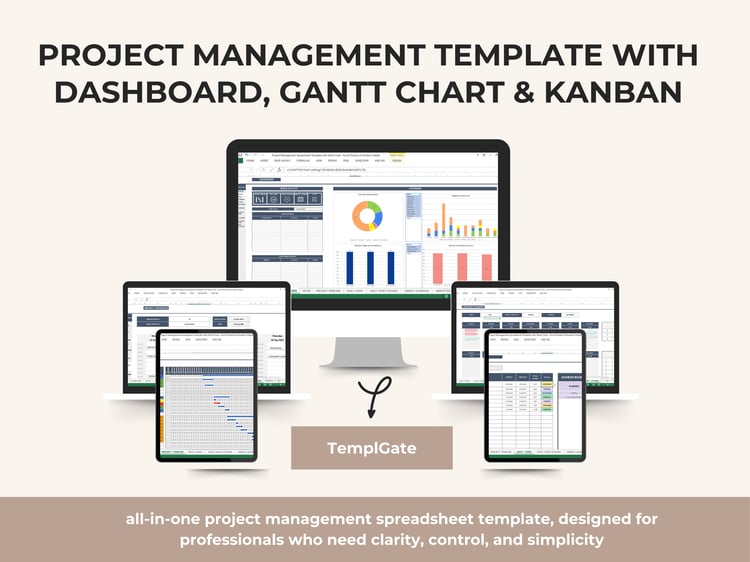
The Baseline Scope Tracker is a comprehensive, executive-level project management system built for teams that require strict scope control, structured change management, and complete baseline version tracking.
Designed for complex projects and governance-driven environments, this premium template provides a fully integrated framework to manage scope from initial baseline approval through re-baselines, change requests, impact assessments, stakeholder governance, and executive reporting.
It is not just a tracker — it is a complete scope control operating system.
Why This Template Matters
Uncontrolled scope changes are one of the leading causes of:
• Budget overruns
• Schedule delays
• Stakeholder conflict
• Governance breakdown
The Baseline Scope Tracker ensures every scope item is traceable, versioned, approved, assessed for impact, and transparently reported at the executive level.
This template is ideal for:
• Enterprise programs
• PMOs and governance boards
• Large digital transformation initiatives
• Cross-functional product development teams
• Regulated environments requiring audit trails
What’s Inside the Baseline Scope Tracker
This premium workbook includes fully connected modules covering the entire scope lifecycle.
1. Executive Dashboard
A real-time executive reporting interface that summarizes:
• Total scope items
• Completion rate
• Items at risk
• Active change requests
• Effort variance
• Open risks
Visual insights include:
• Scope status distribution
• Health distribution
• Change request decisions
• Baseline effort growth
• Category breakdown
• Monthly change trend
This allows sponsors and steering committees to immediately understand scope health and drift.
2. Scope Register — Master Scope Control
The central repository of all scope items.
Tracks:
• Scope ID and description
• Category and phase
• Priority and ownership
• Baseline version reference
• Original vs current estimates
• Effort variance and percentage change
• Status and health indicators
• Target and actual dates
• Notes and documentation references
Every scope item is version-aware and variance-controlled.
3. Baseline Log — Version History Control
Complete baseline version tracking with:
• Baseline ID and version
• Date established
• Approved by
• Total scope items
• Total estimated hours
• Budget values
• Items added / removed / modified
• Re-baseline justification
• Status and document references
This creates a formal governance audit trail for every baseline evolution.
4. Change Request Log — Structured Change Management
Full change control process including:
• CR ID and submission date
• Change type (addition, removal, modification)
• Impact level
• Schedule impact (days)
• Cost impact ($)
• Effort impact (hours)
• Risk assessment
• Approval status
• Implementation tracking
No change enters the project without visibility and impact evaluation.
5. Scope Comparison — Baseline vs Current
Side-by-side scope drift analysis:
• Original baseline vs current baseline
• Effort variance
• Schedule variance
• Scope drift flag
• Commentary
Instantly identify:
• Added scope
• Modified scope
• Removed items
• Major variance triggers
This sheet highlights silent scope creep before it becomes a budget crisis.
6. Impact Analysis — Multi-Dimensional Assessment
For every approved or proposed change:
• Schedule impact
• Cost impact
• Quality impact
• Resource impact
• Risk impact
• Overall impact score
• Dependencies affected
• Mitigation strategy
• Residual risk
This supports informed decision-making at governance level.
7. Approval Tracker — Governance & Sign-Off Log
Tracks formal approvals for:
• Baselines
• Change requests
• Major modifications
Includes:
• Approver
• Decision date
• Turnaround time
• Escalation requirement
• Follow-up actions
Perfect for audit compliance and executive accountability.
8. Deliverables Tracker — Output & Milestone Control
Connects scope to deliverables with:
• Linked scope references
• Baseline version alignment
• Ownership
• Due dates
• % completion
• Health indicators
• Quality gate status
• Acceptance criteria
Ensures scope translates into measurable outputs.
9. Work Breakdown Structure (WBS)
Hierarchical scope decomposition:
• Multi-level structure
• Estimated vs actual hours
• Status tracking
• Dependency mapping
• Baseline linkage
Forms the structural backbone of the scope plan.
10. Stakeholder Register
Tracks:
• Influence level
• Interest level
• Scope authority
• Communication frequency
• Engagement strategy
• Key concerns
Aligns scope governance with stakeholder power dynamics.
11. Risk Register — Scope-Specific Risk Control
Tracks scope-related risks including:
• Probability and impact scoring
• Risk level classification
• Trigger events
• Mitigation strategy
• Contingency plans
• Ownership
• Review dates
Directly connected to scope drift and change management.
12. Meeting Log — CCB & Scope Reviews
Complete governance meeting history including:
• Baseline approvals
• CCB decisions
• Action items
• Owners
• Due dates
• Documentation references
Ensures traceability from discussion to decision.
Key Advantages
✔ Full baseline version control
✔ Executive-ready reporting
✔ Complete change governance
✔ Impact scoring framework
✔ Scope drift detection
✔ Audit-ready approval tracking
✔ Cross-sheet traceability
✔ No macros required
✔ Clean, enterprise-level structure
✔ Suitable for large-scale programs
Who Should Use This Template?
• Project Managers handling complex initiatives
• PMO leaders enforcing governance standards
• Program Managers managing multi-stream scope
• Enterprise IT transformation teams
• Construction & infrastructure programs
• Product development organizations
• Organizations with formal change control boards
The Outcome You Get
With the Baseline Scope Tracker, you gain:
• Controlled scope evolution
• Reduced surprise overruns
• Transparent executive communication
• Formal governance compliance
• Early detection of scope drift
• Better budget predictability
• Structured decision-making
This template transforms scope management from reactive firefighting into disciplined governance.